


MODULE
Demand Intelligence Agent
The Forecast That Builds Itself and Gets Better Every Day
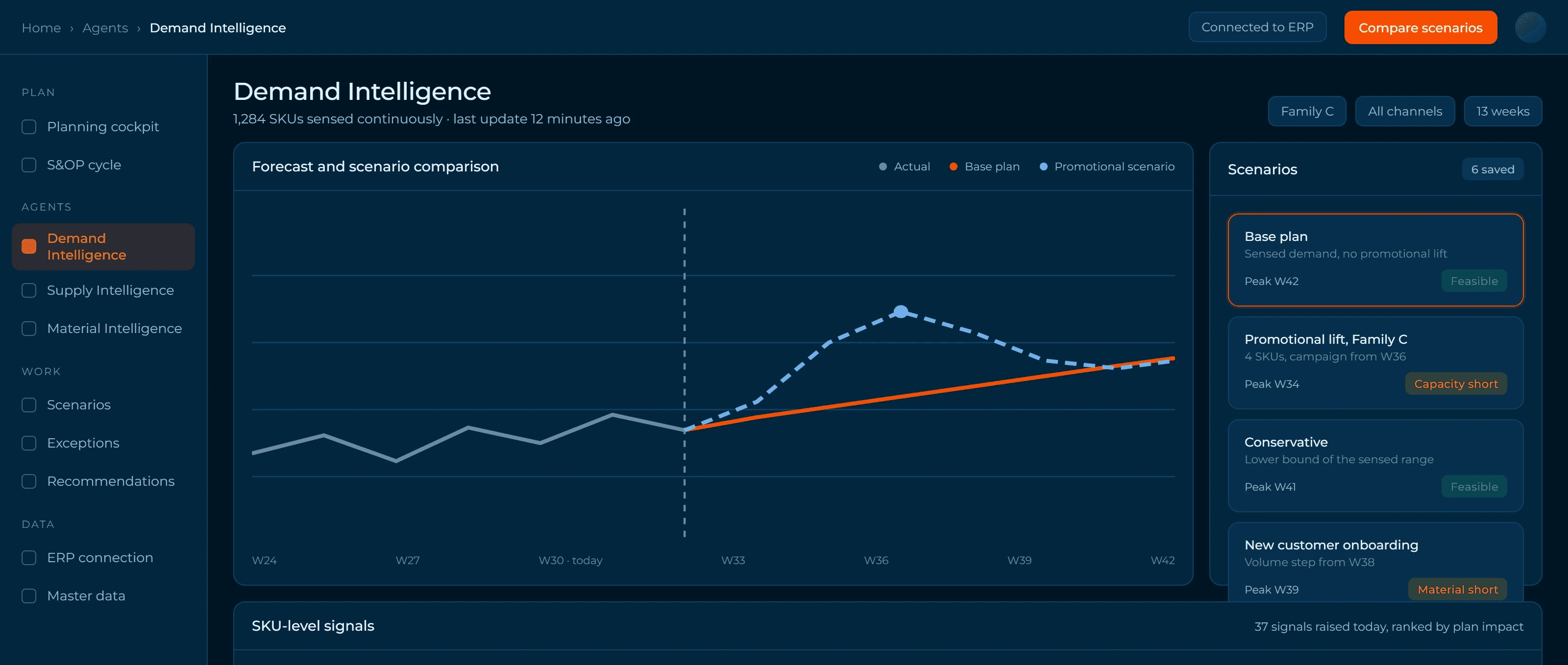
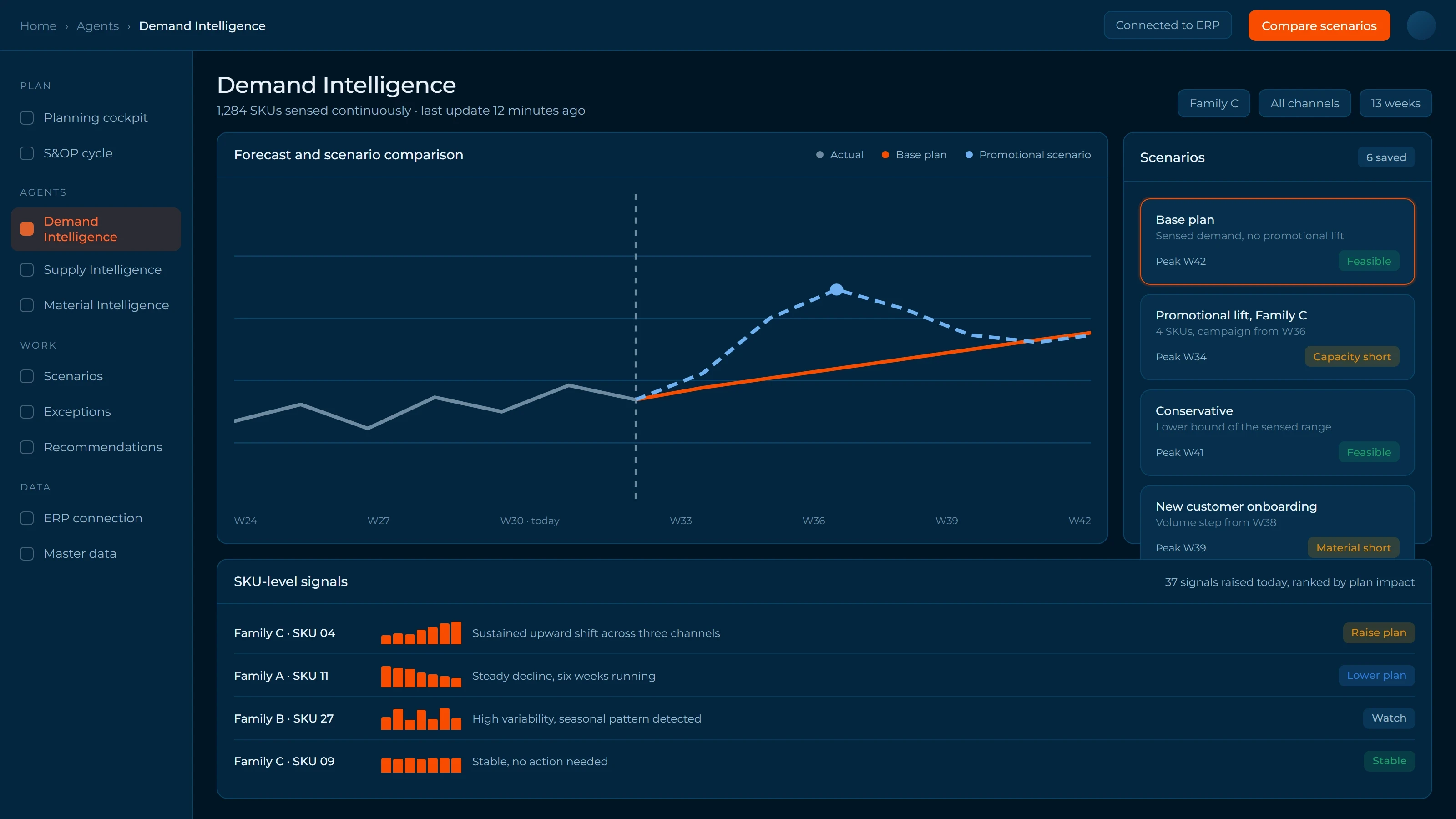
The Demand Intelligence Agent replaces the manual forecast cycle. It ingests sales history, promotional calendars, distributor data, and external signals then produces a dynamic demand plan by SKU, region, and customer segment. Confidence levels and anomaly alerts are built in. No spreadsheet handoffs. No monthly reset.

Your Forecast Is Already Wrong by the Time It's Finished
The typical demand planner spends 3 to 5 days building a forecast in Excel. They pull sales history from one system, promotional calendars from another, and distributor sell-through from a third. By the time the numbers are consolidated, the inputs are stale.
The forecast updates monthly. The market does not. Promotional lifts are estimated from gut feel or last year's actuals. When volume spikes, you stock out. When it does not, you sit on excess inventory.
According to the IBF, 79% of S&OP leaders say their planning effectiveness is limited by data quality and timeliness. Planners spend 65 to 75 percent of their time gathering and reconciling data — not analyzing it.
The problem is not the planner. The problem is the process.


Why This Matters
65 to 75% of planner time goes to data gathering (Gartner). The forecast is already stale by the time the S&OP meeting starts. Demand sensing not monthly forecasting is what separates companies that hit OTIF targets from those that pay fines. In CPG and food manufacturing, OTIF penalty exposure from forecast-driven stockouts ranges from $1 million to $5 million annually per major retailer relationship. The cost of poor forecasting is not just inventory carrying cost it is lost shelf space, retailer scorecard deductions, and expediting charges that erode margin. Companies that have moved from monthly statistical forecasting to continuous demand sensing report 15 to 30% improvements in MAPE (McKinsey), translating directly into inventory reduction and service level improvement.
How It Works
Continuous Sensing, Not Monthly Guessing
Forecast Accuracy Improvement
Organizations adopting AI-driven demand sensing report 15 to 30 percent MAPE improvement over traditional statistical methods (McKinsey). The agent delivers that improvement from the first planning cycle. For a mid-market manufacturer with $200M in revenue, a 20% MAPE improvement translates to significant reductions in both stockout frequency and excess inventory carrying cost.
Planner Time Redirected
Data gathering drops from 65-75% of planner time to near zero. Your demand planners spend their hours on exception management, commercial insight, and cross-functional alignment — the high-value activities that no algorithm can replace.
Promotional Lift Modeled, Not Guessed
Promotional volume is incorporated into the base forecast using historical lift curves and real-time sell-through. Stockouts and excess from promotional misreads are reduced materially. For CPG manufacturers running 50 to 100 promotions per year, the financial impact of accurate promotional forecasting is substantial.
Forecast Freshness
The plan updates daily. S&OP reviews begin with a current, defensible number — not a stale spreadsheet that everyone wants to override. The S&OP conversation shifts from debating the forecast to making decisions about how to respond to what the forecast reveals.
Expected Outcomes:
In early deployments, MAPE has improved by 20-30% compared to the previous statistical forecasting baseline.
Planner time spent on data gathering and reconciliation has dropped from 65-75% to below 10%, freeing capacity for exception management and commercial collabora
Forecast Bias KPIs have stabilized, with systematic over- and under-forecasting identified and corrected within the first two planning cycles.
Related Modules & Pages
Related Use Cases
Replace the Monthly Forecast Cycle
Your planners deserve better tools than spreadsheets and stale data. The Demand Intelligence Agent delivers a continuously updated, confidence-scored demand plan so your team can focus on decisions, not data gathering. See what demand sensing looks like in your planning environment.