

Home
Products
Manvis
SENSE
Manvis
Vision, Transferred.
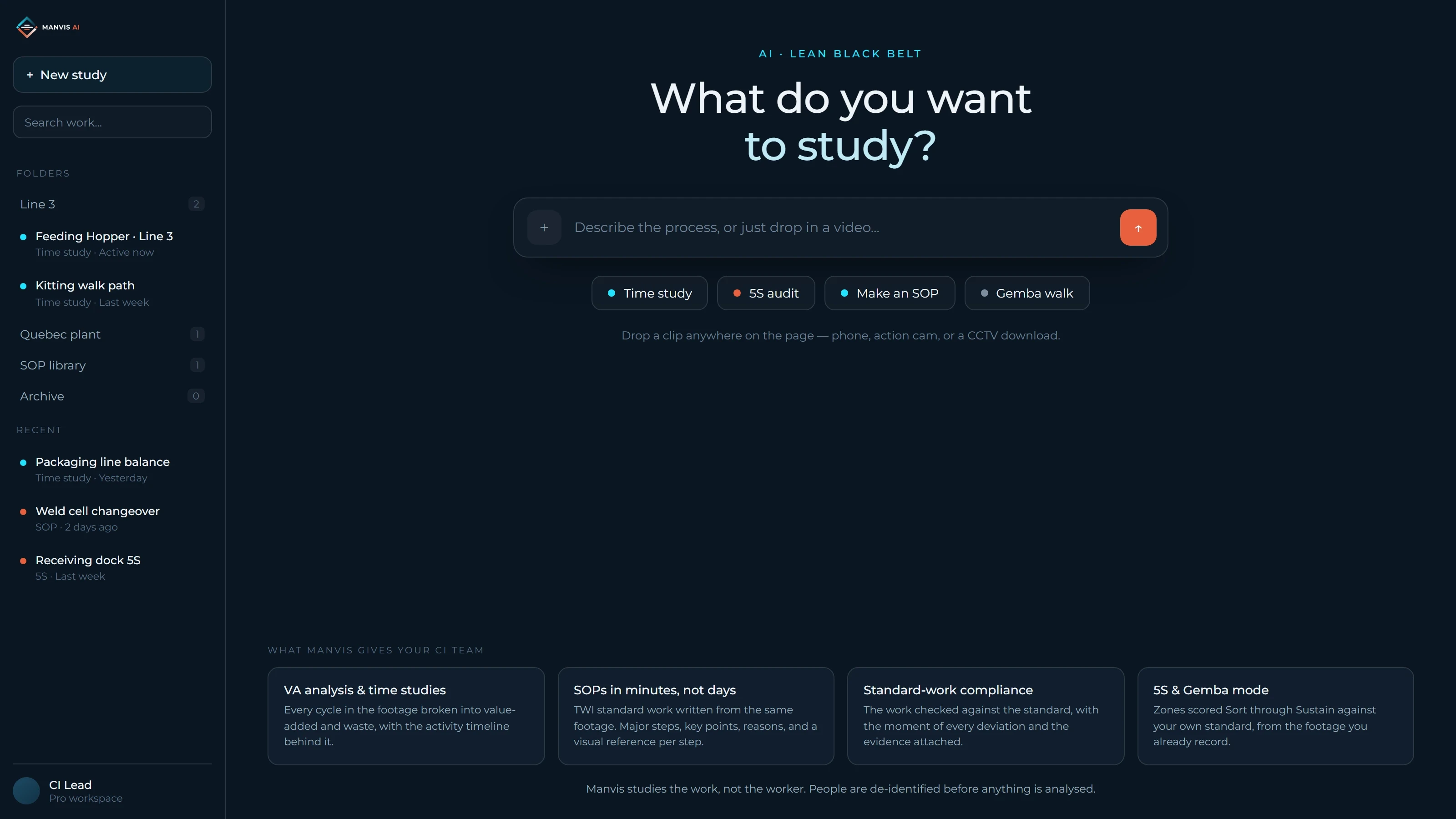
Footage of the work your people already do, turned into the answers your CI team needs. Give Manvis a saved clip or a download from the CCTV you already run, and it reads the work the way an experienced industrial engineer would, on every station you have footage for.
The Cost of Studying a Sample
A manual time study takes an industrial engineer two to five days per workstation (IIE). That constraint has not moved in thirty years, and it decides everything downstream. Most plants plan more studies than they finish, so the stations that get measured are the ones somebody had time for rather than the ones that needed it. Everything else runs on a cycle time nobody has checked, against a standard nobody has verified. The cost is not the study you skipped. It is the line balance built on an assumption, the SOP written from memory instead of from the work, and the improvement you cannot prove because there was never a measured before. The footage of those stations already exists. Your cameras recorded it, and nobody has the days it would take to go through it by hand.

What the Footage Already Holds
Most plants already record more footage in a week than a CI team could work through in a year. The footage is not the constraint. Reading it is. Inside a single recorded cycle there is a value-added and non-value split, the eight wastes laid out on a timeline, the real sequence an operator followed rather than the one the binder describes, and every point where the work departed from the standard. None of that needs new hardware, a new sensor, or a change to the line. It needs the footage read properly. Manvis returns it as an artifact you can open: the time study, the TWI standard operating procedure written from the work itself, the 5S and standard-work score against your own definition, and the deviations with the cycle they occurred in and the evidence attached. People are de-identified before anything is analysed, because the subject is the work, not the worker. A CI agent then picks the findings up and carries them with your engineers.
What Changes With
Manvis
Before Manvis
A study takes an engineer two to five days per station
Most planned studies never happen.
The standard was written from memory, not from the work
Adherence is known on audit day and guessed at the rest of the time
Improvement cannot be proved, because there is no measured before
After Manvis
A study takes hours, from footage you already have
Every station you have footage for can be studied, not just the sampled few
The standard is written from the work itself in TWI format, and translates into eleven languages for a multilingual floor.
Adherence is scored on every shift you have footage for, with the evidence on each gap
The before and after are both measured, so the gain is defensible.
Three Capabilities. One Sensing Layer.
The Numbers
Two to five days: one workstation study, by hand (IIE).
Hours: the same study from footage you already have
CI programmes that fail to sustain past twelve months (AME and the Shingo Institute).
languages a TWI standard translates into.
Supporting industry data:
$1.7 trillion — global annual cost of quality failures in manufacturing (ASQ/NIST)
Manufacturers spend 20% of revenue on cost of poor quality (ASQ)
Human inspection accuracy: 80-85% ideal; 60-70% under fatigue (MIT Human Factors)
-E time studies: 2-5 days per workstation; most plants complete <20% of planned studies/year (IIE)
The Business Case
The ROI Model
Start with what a study costs you today. Two to five days of an industrial engineer per workstation, multiplied by the number of stations you would study if capacity were not the limit. That number is the size of the problem, and for most plants it is the reason the majority of their processes have no current documentation. Manvis does not replace the engineer. It removes the days of stopwatch work that sit in front of the judgement, so the same team covers every station instead of a sample. The second return is slower and larger: standards written from the work hold better than standards written from memory, and adherence you can measure on any shift you have footage for is adherence you can actually manage.
Built for the Teams That Own Continuous Improvement
1
CI and Lean Managers
By hand you study a handful of stations a year, chosen by whatever is loudest that month. Manvis studies every station you have footage for and returns the ranked gaps, so the next kaizen is the one with the largest measured gain behind it.
2
IE Managers
Two to five days per station is why the study backlog never clears. From footage the same study takes hours, and returns a value-added split, the eight wastes on a timeline, and a TWI standard.
3
Operations Managers
Standard work checked across shifts and sites, so you can tell which lines hold the standard and which drift, from footage you already keep.
4
Plant Managers
Standards that reflect how the plant actually runs, and an audit trail produced as a by-product of the work rather than assembled the week before the auditor arrives.
Purpose-Built for Manufacturing

Part of the SME-Empowerment Platform
Manvis is the sensing layer of the SENSE → PLAN → EXECUTE platform:
Manvis is powerful alone. Connected to the platform, every detection becomes an action, every observation becomes intelligence, and the loop never stops closing.
Why Manvis, Not a Fixed Vision System
Fixed Vision Systems
Set up for one check per deployment, fixed to one station and one camera position.
New question, new configuration, and often new hardware
Built to pass or fail a part, so it has nothing to say about method, sequence or waste.
Manvis
Works on footage you already record, so there is nothing to install at the station.
What you get depends on what you ask: a time study today, a TWI standard tomorrow, a 5S score on the same clip.
It reads method and sequence rather than pass or fail, which is why the output is an engineering artifact and not an alarm.
Common Questions
We already have Cognex / Keyence.
Our inspectors are experienced — we trust them.
We don't have camera infrastructure.
The cameras feel like surveillance.
Put Manvis on Your Own Footage
Book a consultation. We will walk through the five pillars in the context of your plant your quality challenges, your inspection process, your camera infrastructure, your use cases.