


MODULE

Material Intelligence Agent

Shortages Predicted Weeks Before the Line Stops

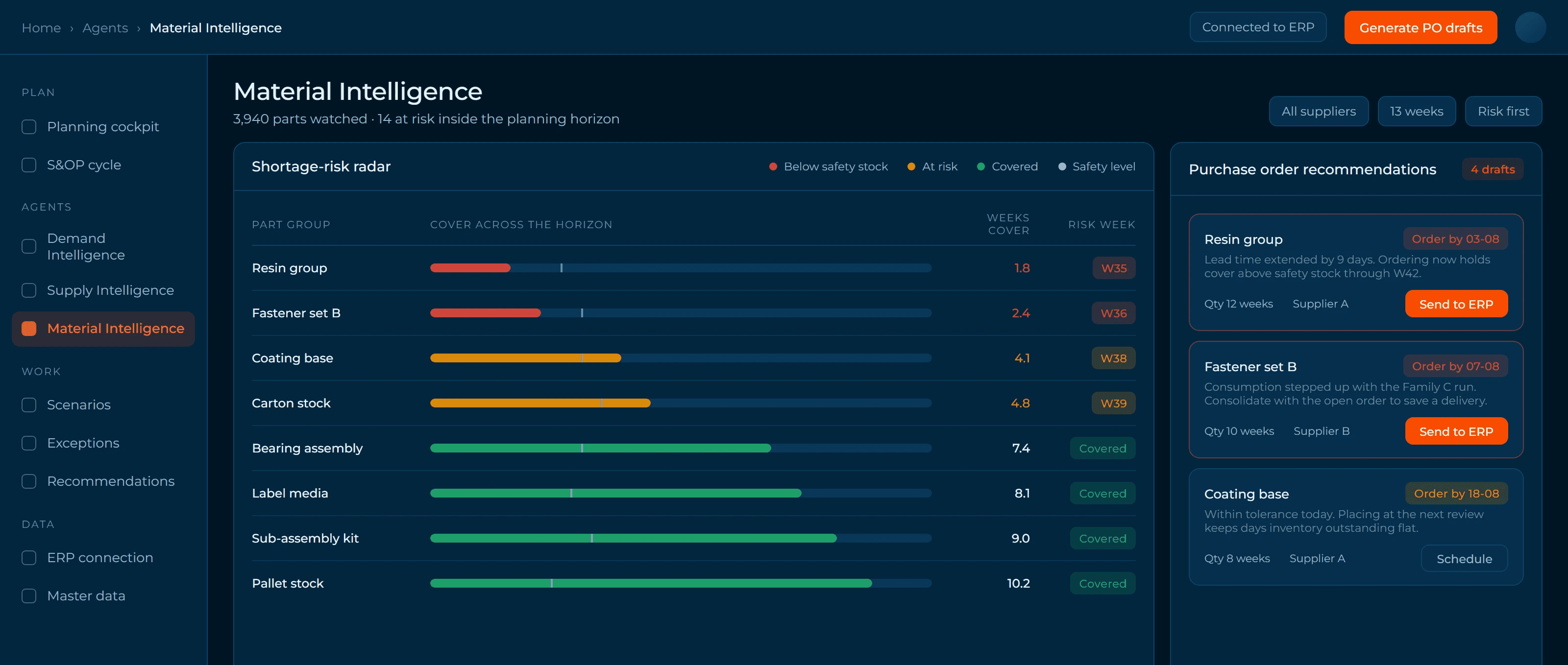
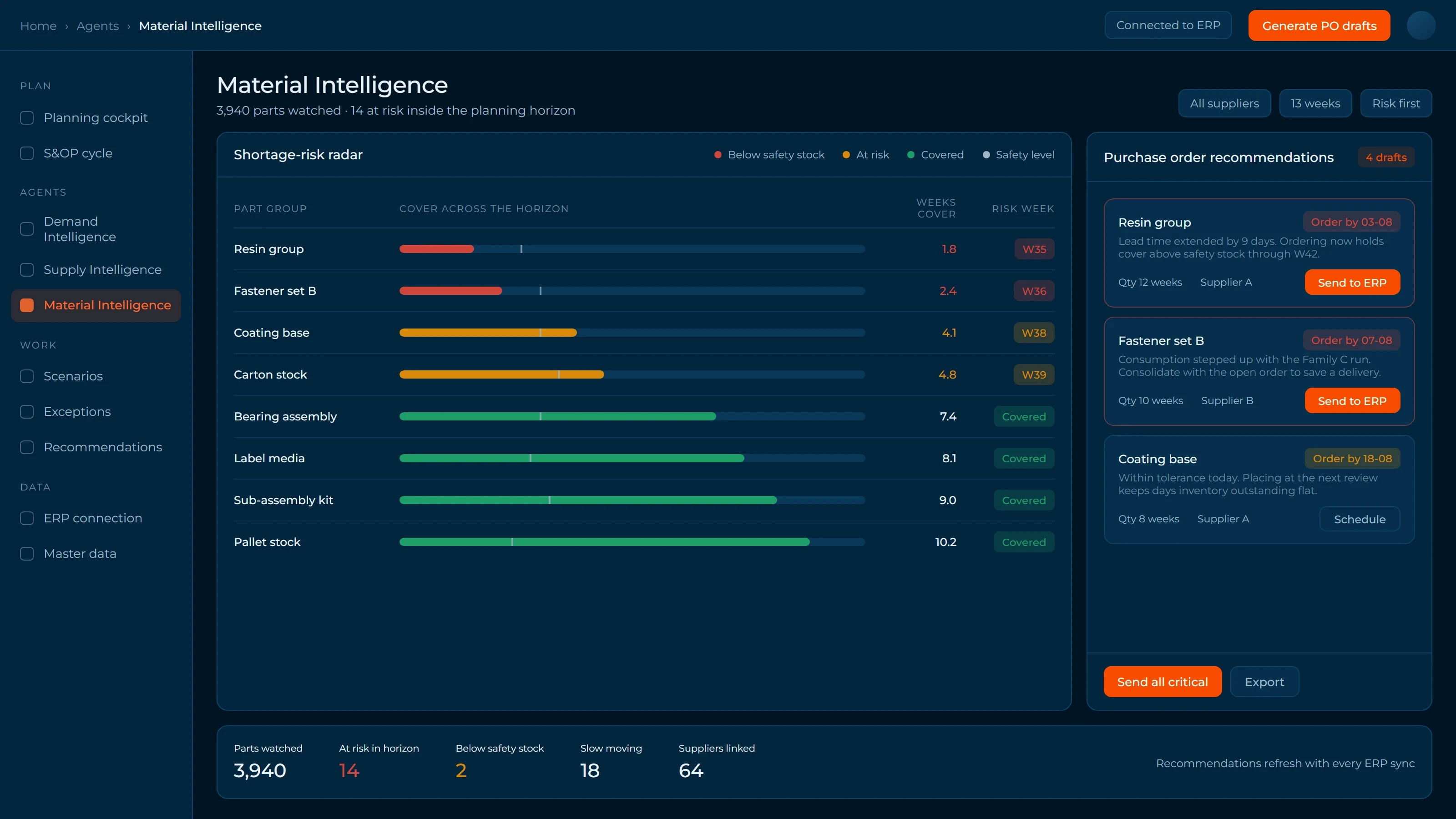
The Material Intelligence Agent monitors your bill of materials, current inventory, open purchase orders, and supplier performance against the live production schedule. It predicts shortages 2 to 6 weeks ahead, generates purchase order recommendations, and scores supplier reliability continuously. Your material planner stops reacting to line stops and starts preventing them.

You Find Out About Shortages When the Line Stops

The material plan is built from a static BOM explosion and an ERP inventory snapshot. By the time it is complete, the numbers are already outdated. Open purchase orders are assumed to arrive on time. Supplier lead times are treated as fixed. Neither assumption holds reliably.

The result: shortages are discovered when the production line stops. The material planner scrambles to expedite. Air freight costs spike. Delivery commitments slip. In CPG manufacturing alone, OTIF penalty exposure from preventable shortages runs between $1 million and $5 million annually.

There is no supplier risk scoring. There is no early warning system. There is only reaction. The material planner's day is defined by firefighting — chasing expedites, calling suppliers for status updates, and manually cross-referencing the BOM against inventory positions that changed since the last snapshot. The value-added work — strategic sourcing, supplier development, inventory optimization — never gets done because the urgent always displaces the important.


seven construction workers standing on white field

Why This Matters

Material shortages are the single most common cause of unplanned production downtime in discrete and process manufacturing. According to APICS, material-related schedule disruptions account for 25 to 40% of all unplanned downtime events. The cost extends beyond the idle line: expediting charges (air freight costs 4 to 6 times standard shipping), overtime to recover lost production, missed delivery commitments, and the cascading impact on downstream operations. Days Inventory Outstanding (DIO) optimization is impossible when material planning is reactive — plants carry excess safety stock on some items while experiencing critical shortages on others. The shortage prediction horizon — how far ahead a plant can see an incoming gap — determines whether the response is planned procurement or emergency firefighting.

How It Works

Predictive Material Management, Not Reactive Firefighting

Live Material Position

The agent maintains a continuous view of current inventory, open purchase orders, inbound shipments, and committed production requirements. The material position is always current, not a point-in-time snapshot. BOM explosion runs continuously against the live production schedule, so material requirements reflect what is actually being built — not what was planned last week. Inventory data is reconciled across warehouses, staging areas, and in-transit positions, providing a single source of truth for material availability.

Supplier Performance Scoring

The agent tracks on-time delivery rates, lead time variability, quality rejection rates, and responsiveness for every supplier. Performance scores are updated continuously and surfaced alongside PO recommendations so planners make sourcing decisions with current data. Supplier scoring replaces the anecdotal evaluation that defines most mid-market procurement relationships. When a supplier's on-time delivery rate drops from 92% to 78% over three months, the data is visible before the next shortage occurs — not after.

Shortage Prediction

By comparing the live material position against the production schedule from the Supply Intelligence Agent, the agent identifies potential shortages 2 to 6 weeks before they would impact the line. Each alert includes the affected SKUs, production runs, estimated impact window, and the specific materials driving the gap. The prediction horizon adapts based on supplier lead times — materials with longer lead times are monitored further ahead. This is the difference between a 2-week shortage prediction horizon and no horizon at all: the difference between standard procurement and emergency expediting.

Risk Monitoring and Escalation

When a supplier's adherence trends downward or a critical material's coverage drops below threshold, the agent escalates the risk with recommended corrective actions — alternative suppliers, safety stock adjustments, or production schedule modifications. Risk monitoring is continuous and multi-dimensional: it considers not just whether a supplier is late today, but whether their trajectory suggests they will be late next month. Escalation is configurable by material criticality — a risk on an A-class component triggers immediate attention, while a risk on a C-class consumable may trigger a routine review.

Purchase Order Recommendations

When a shortage is predicted or a reorder point is approached, the agent generates a purchase order recommendation with suggested supplier, quantity, and required delivery date. Human approval thresholds are configurable — routine replenishments can be auto-approved while exceptions require planner sign-off. PO recommendations consider supplier performance scores, current pricing, minimum order quantities, and lead time variability — surfacing the best sourcing option rather than defaulting to the last supplier used. PO automation reduces the administrative burden on procurement teams while maintaining appropriate control over spending decisions.

Live Material Position

The agent maintains a continuous view of current inventory, open purchase orders, inbound shipments, and committed production requirements. The material position is always current, not a point-in-time snapshot. BOM explosion runs continuously against the live production schedule, so material requirements reflect what is actually being built — not what was planned last week. Inventory data is reconciled across warehouses, staging areas, and in-transit positions, providing a single source of truth for material availability.

Shortage Prediction

By comparing the live material position against the production schedule from the Supply Intelligence Agent, the agent identifies potential shortages 2 to 6 weeks before they would impact the line. Each alert includes the affected SKUs, production runs, estimated impact window, and the specific materials driving the gap. The prediction horizon adapts based on supplier lead times — materials with longer lead times are monitored further ahead. This is the difference between a 2-week shortage prediction horizon and no horizon at all: the difference between standard procurement and emergency expediting.

Purchase Order Recommendations

When a shortage is predicted or a reorder point is approached, the agent generates a purchase order recommendation with suggested supplier, quantity, and required delivery date. Human approval thresholds are configurable — routine replenishments can be auto-approved while exceptions require planner sign-off. PO recommendations consider supplier performance scores, current pricing, minimum order quantities, and lead time variability — surfacing the best sourcing option rather than defaulting to the last supplier used. PO automation reduces the administrative burden on procurement teams while maintaining appropriate control over spending decisions.

Supplier Performance Scoring

The agent tracks on-time delivery rates, lead time variability, quality rejection rates, and responsiveness for every supplier. Performance scores are updated continuously and surfaced alongside PO recommendations so planners make sourcing decisions with current data. Supplier scoring replaces the anecdotal evaluation that defines most mid-market procurement relationships. When a supplier's on-time delivery rate drops from 92% to 78% over three months, the data is visible before the next shortage occurs — not after.

Risk Monitoring and Escalation

When a supplier's adherence trends downward or a critical material's coverage drops below threshold, the agent escalates the risk with recommended corrective actions — alternative suppliers, safety stock adjustments, or production schedule modifications. Risk monitoring is continuous and multi-dimensional: it considers not just whether a supplier is late today, but whether their trajectory suggests they will be late next month. Escalation is configurable by material criticality — a risk on an A-class component triggers immediate attention, while a risk on a C-class consumable may trigger a routine review.

Live Material Position

The agent maintains a continuous view of current inventory, open purchase orders, inbound shipments, and committed production requirements. The material position is always current, not a point-in-time snapshot. BOM explosion runs continuously against the live production schedule, so material requirements reflect what is actually being built — not what was planned last week. Inventory data is reconciled across warehouses, staging areas, and in-transit positions, providing a single source of truth for material availability.

Purchase Order Recommendations

When a shortage is predicted or a reorder point is approached, the agent generates a purchase order recommendation with suggested supplier, quantity, and required delivery date. Human approval thresholds are configurable — routine replenishments can be auto-approved while exceptions require planner sign-off. PO recommendations consider supplier performance scores, current pricing, minimum order quantities, and lead time variability — surfacing the best sourcing option rather than defaulting to the last supplier used. PO automation reduces the administrative burden on procurement teams while maintaining appropriate control over spending decisions.

Risk Monitoring and Escalation

When a supplier's adherence trends downward or a critical material's coverage drops below threshold, the agent escalates the risk with recommended corrective actions — alternative suppliers, safety stock adjustments, or production schedule modifications. Risk monitoring is continuous and multi-dimensional: it considers not just whether a supplier is late today, but whether their trajectory suggests they will be late next month. Escalation is configurable by material criticality — a risk on an A-class component triggers immediate attention, while a risk on a C-class consumable may trigger a routine review.

Shortage Prediction

By comparing the live material position against the production schedule from the Supply Intelligence Agent, the agent identifies potential shortages 2 to 6 weeks before they would impact the line. Each alert includes the affected SKUs, production runs, estimated impact window, and the specific materials driving the gap. The prediction horizon adapts based on supplier lead times — materials with longer lead times are monitored further ahead. This is the difference between a 2-week shortage prediction horizon and no horizon at all: the difference between standard procurement and emergency expediting.

Supplier Performance Scoring

The agent tracks on-time delivery rates, lead time variability, quality rejection rates, and responsiveness for every supplier. Performance scores are updated continuously and surfaced alongside PO recommendations so planners make sourcing decisions with current data. Supplier scoring replaces the anecdotal evaluation that defines most mid-market procurement relationships. When a supplier's on-time delivery rate drops from 92% to 78% over three months, the data is visible before the next shortage occurs — not after.

What This Means for Your Material Operations

Shortages Predicted, Not Discovered

Material gaps are identified 2 to 6 weeks before they reach the production floor. The shift from reactive to predictive eliminates the most expensive category of unplanned downtime. The shortage prediction horizon — measured in weeks of forward visibility — becomes a key operational KPI.

OTIF Penalty Exposure Reduced

Preventable shortages that cascade into missed deliveries carry significant financial penalties. Organizations using predictive material planning report $1 million to $5 million in avoidable OTIF fines annually in CPG operations alone. The financial case for predictive material management is immediate and measurable.

Supplier Accountability Established

Continuous performance scoring replaces anecdotal supplier evaluation. Procurement decisions are grounded in data. Underperforming suppliers are identified before they cause disruption, not after. Supplier development conversations shift from subjective feedback to data-driven reviews with trend analysis.

Expediting Costs Reduced

When shortages are predicted weeks ahead, standard lead-time procurement replaces emergency air freight and spot buys. The cost difference is material — air freight typically runs 4 to 6 times the cost of standard shipping. Over a year, the savings from avoided expediting often exceed the investment in the system.

Expected Outcomes:

In early deployments, material-related unplanned downtime has decreased by 40 to 60% as shortages are identified and resolved before they reach the line.

Days Inventory Outstanding has improved by 10 to 20% through better demand-supply-material alignment and reduced safety stock buffers on over-stocked items.

Expediting costs (air freight, spot buys, overtime) have decreased by 30 to 50% as standard procurement replaces emergency purchasing.
Related Modules & Pages

Related Use Cases

Stop Discovering Shortages on the Production Floor

Your material planners should not learn about a shortage when the line goes down. The Material Intelligence Agent predicts gaps weeks ahead, recommends corrective action, and holds suppliers accountable with continuous performance data. See what predictive material management looks like in your supply chain.