


MODULE

Supply Intelligence Agent

A Production Schedule That Adapts Before You Ask It To

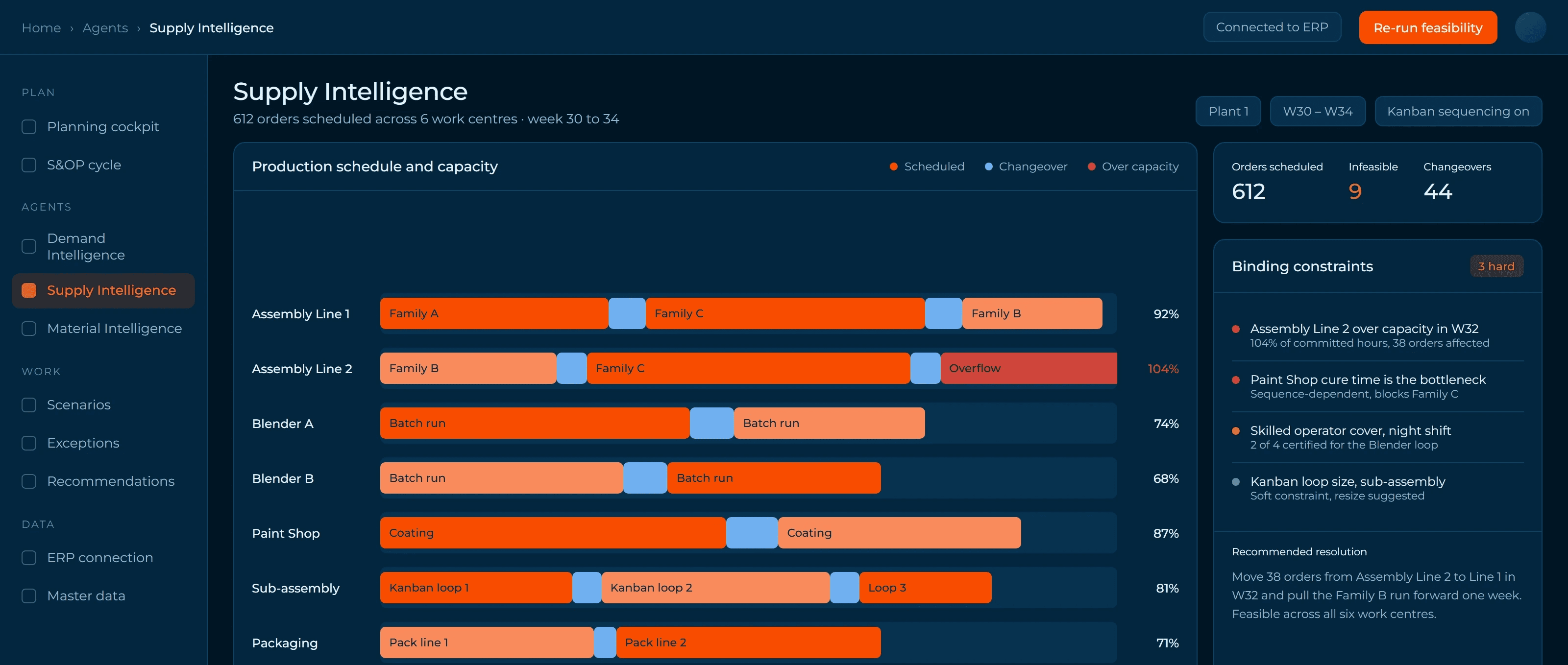
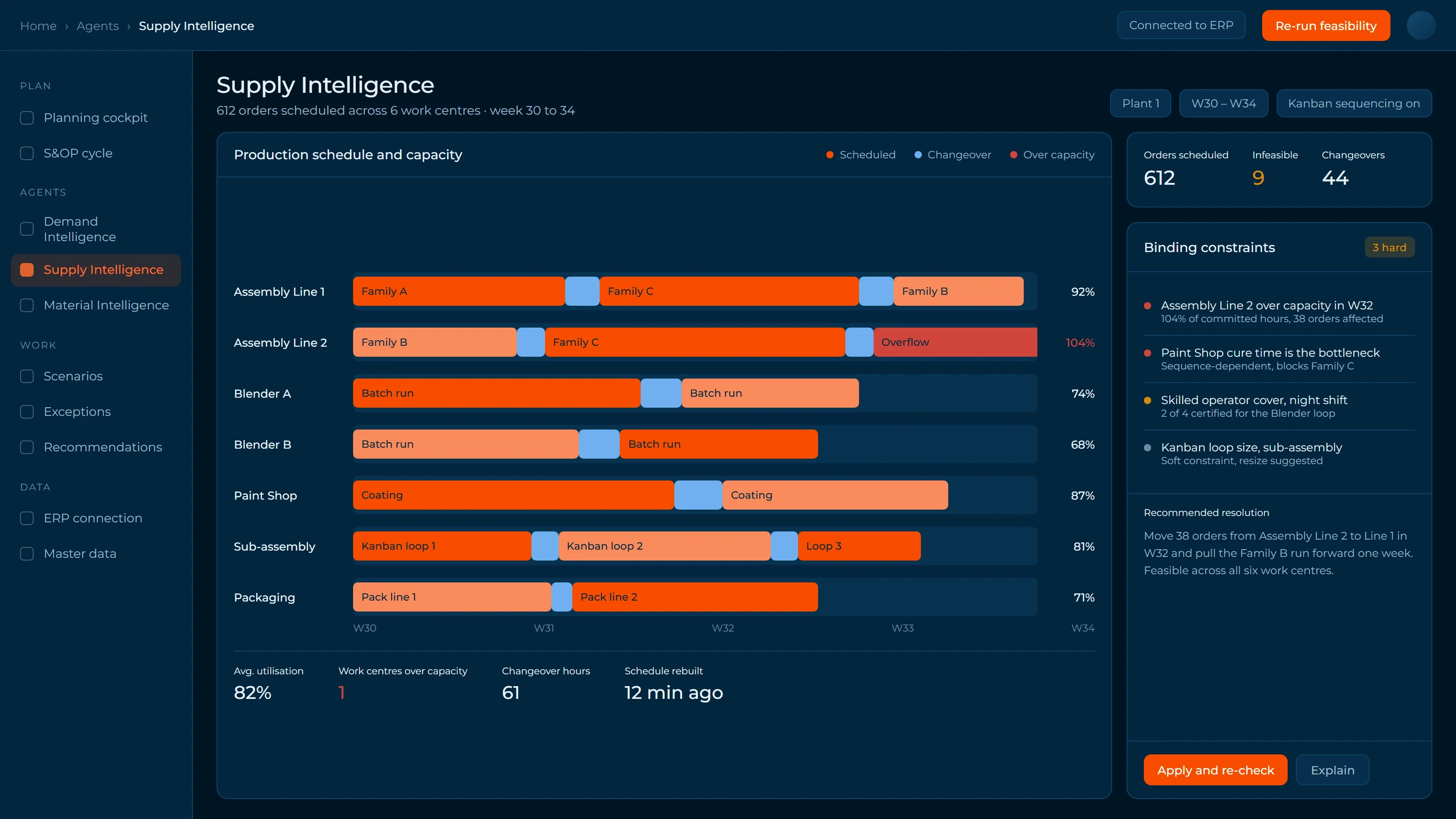
The Supply Intelligence Agent takes the demand plan from the Demand Intelligence Agent and produces an optimized master production schedule — constrained by capacity, maintenance windows, and lead times. It runs scenario analysis automatically and re-plans in real time when execution deviates from the approved plan. Your supply planner stops reconciling spreadsheets and starts managing exceptions.

Your Production Plan Is Static in a World That Is Not

The supply planner takes the demand forecast — often already a week old — and spends two days building a production schedule. Capacity constraints are checked manually against maintenance calendars. Lead times are assumed, not verified. The result is a plan that reflects the world as it was, not as it is.

When a line goes down or a supplier is late, the plan breaks. Re-planning is manual, slow, and disruptive. There is no systematic way to evaluate alternative scenarios. The S&OP meeting spends three hours debating a plan that everyone knows is already compromised. The master production schedule is the central artifact of manufacturing operations.

When it is static, every downstream decision — material procurement, labor scheduling, customer commitments — is built on a foundation that has already shifted. The cost of a static MPS is not just inefficiency. It is systemic misalignment between plan and reality.


seven construction workers standing on white field

Why This Matters

According to Gartner, fewer than 10% of manufacturers have achieved what they define as "adaptive supply chain planning" — the ability to re-plan continuously based on real-time execution data. The remaining 90% operate on static schedules that are outdated within hours of publication. The consequence is measurable: plants operating on static MPS report 15 to 25% higher schedule adherence variance, 20 to 30% more unplanned changeovers, and significantly higher expediting costs. When the plan does not reflect reality, the floor improvises — and improvisation creates waste, quality risk, and Takt time misalignment across the value stream.

How It Works

Constraint-Aware Planning That Runs Continuously

Demand-to-Supply Translation

The agent receives the live demand plan from the Demand Intelligence Agent and translates it into a production requirement by SKU, line, and time period. No manual handoff. No version mismatch. The translation accounts for finished goods inventory positions, safety stock targets, and customer service level requirements — producing a net production requirement that reflects what actually needs to be made, not a gross demand number that ignores what is already on hand.

Real-Time Re-Planning

When execution deviates from plan — a line runs behind schedule, an order is expedited, a shift is cancelled — the agent recalculates the schedule and surfaces the revised plan with impact analysis. Re-planning is not a manual process triggered by a planner noticing the deviation. It is automatic, continuous, and immediate. The revised schedule includes a clear view of what changed, why, and what the downstream impact is — enabling informed approval rather than reactive scrambling.

Constraint-Aware Scheduling

The master production schedule is generated with full visibility into line capacity, maintenance windows, changeover times, and labor availability. Every production slot is feasible before it is published. Takt time alignment is verified at the line level — ensuring that the schedule does not overload workstations or create bottlenecks that cascade through the value stream. Kanban-sequenced lines receive scheduling logic that respects pull signals, while batch-process lines receive optimized batch sequencing that minimizes changeover frequency.

BOM and Capacity Integration

Bill of materials and capacity data are ingested directly from the ERP. The agent maintains a live model of what can be produced, when, and in what quantity. BOM explosion runs against the schedule to verify material availability before production slots are confirmed — creating a pre-check that prevents the common failure mode of scheduling production for which materials are not yet available. Capacity is modeled at the work center level, accounting for both equipment capacity and labor constraints.

Automated Scenario Analysis

The agent runs multiple what-if scenarios automatically — demand increases of 10 or 20 percent, a production line down for maintenance, a key supplier delay, a labor shortage on a specific shift. Planners review pre-built alternatives rather than building them from scratch. Each scenario includes the impact on delivery commitments, inventory positions, and capacity utilization — giving the S&OP team the information needed to make decisions rather than build analyses.

Demand-to-Supply Translation

The agent receives the live demand plan from the Demand Intelligence Agent and translates it into a production requirement by SKU, line, and time period. No manual handoff. No version mismatch. The translation accounts for finished goods inventory positions, safety stock targets, and customer service level requirements — producing a net production requirement that reflects what actually needs to be made, not a gross demand number that ignores what is already on hand.

Constraint-Aware Scheduling

The master production schedule is generated with full visibility into line capacity, maintenance windows, changeover times, and labor availability. Every production slot is feasible before it is published. Takt time alignment is verified at the line level — ensuring that the schedule does not overload workstations or create bottlenecks that cascade through the value stream. Kanban-sequenced lines receive scheduling logic that respects pull signals, while batch-process lines receive optimized batch sequencing that minimizes changeover frequency.

Automated Scenario Analysis

The agent runs multiple what-if scenarios automatically — demand increases of 10 or 20 percent, a production line down for maintenance, a key supplier delay, a labor shortage on a specific shift. Planners review pre-built alternatives rather than building them from scratch. Each scenario includes the impact on delivery commitments, inventory positions, and capacity utilization — giving the S&OP team the information needed to make decisions rather than build analyses.

Real-Time Re-Planning

When execution deviates from plan — a line runs behind schedule, an order is expedited, a shift is cancelled — the agent recalculates the schedule and surfaces the revised plan with impact analysis. Re-planning is not a manual process triggered by a planner noticing the deviation. It is automatic, continuous, and immediate. The revised schedule includes a clear view of what changed, why, and what the downstream impact is — enabling informed approval rather than reactive scrambling.

BOM and Capacity Integration

Bill of materials and capacity data are ingested directly from the ERP. The agent maintains a live model of what can be produced, when, and in what quantity. BOM explosion runs against the schedule to verify material availability before production slots are confirmed — creating a pre-check that prevents the common failure mode of scheduling production for which materials are not yet available. Capacity is modeled at the work center level, accounting for both equipment capacity and labor constraints.

Demand-to-Supply Translation

The agent receives the live demand plan from the Demand Intelligence Agent and translates it into a production requirement by SKU, line, and time period. No manual handoff. No version mismatch. The translation accounts for finished goods inventory positions, safety stock targets, and customer service level requirements — producing a net production requirement that reflects what actually needs to be made, not a gross demand number that ignores what is already on hand.

Automated Scenario Analysis

The agent runs multiple what-if scenarios automatically — demand increases of 10 or 20 percent, a production line down for maintenance, a key supplier delay, a labor shortage on a specific shift. Planners review pre-built alternatives rather than building them from scratch. Each scenario includes the impact on delivery commitments, inventory positions, and capacity utilization — giving the S&OP team the information needed to make decisions rather than build analyses.

BOM and Capacity Integration

Bill of materials and capacity data are ingested directly from the ERP. The agent maintains a live model of what can be produced, when, and in what quantity. BOM explosion runs against the schedule to verify material availability before production slots are confirmed — creating a pre-check that prevents the common failure mode of scheduling production for which materials are not yet available. Capacity is modeled at the work center level, accounting for both equipment capacity and labor constraints.

Constraint-Aware Scheduling

The master production schedule is generated with full visibility into line capacity, maintenance windows, changeover times, and labor availability. Every production slot is feasible before it is published. Takt time alignment is verified at the line level — ensuring that the schedule does not overload workstations or create bottlenecks that cascade through the value stream. Kanban-sequenced lines receive scheduling logic that respects pull signals, while batch-process lines receive optimized batch sequencing that minimizes changeover frequency.

Real-Time Re-Planning

When execution deviates from plan — a line runs behind schedule, an order is expedited, a shift is cancelled — the agent recalculates the schedule and surfaces the revised plan with impact analysis. Re-planning is not a manual process triggered by a planner noticing the deviation. It is automatic, continuous, and immediate. The revised schedule includes a clear view of what changed, why, and what the downstream impact is — enabling informed approval rather than reactive scrambling.

What This Means for Your Operations

S&OP Meeting Compressed

The S&OP review moves from a three-hour debate over conflicting spreadsheets to a 45-minute decision session. The plan arrives pre-constrained, scenario-tested, and aligned to the latest demand signal. Leadership time is spent on strategic trade-offs, not data reconciliation.

Planner Reconciliation Eliminated

The two-day reconciliation cycle between demand, capacity, and maintenance disappears. The supply planner focuses on exception management and strategic trade-offs — the decisions that require human judgment rather than spreadsheet mechanics.

Schedule Feasibility Guaranteed

Every published schedule has been validated against real constraints — capacity, maintenance, materials, labor. Production supervisors receive a plan they can trust, not one they need to rework on the floor. Schedule adherence improves because the schedule itself is achievable.

Scenario Readiness

When disruptions occur, alternative plans already exist. The response time between disruption and revised schedule drops from days to minutes. This is the operational definition of resilience: not the absence of disruption, but the speed of response.

Expected Outcomes:

In early deployments, S&OP meeting duration has decreased by 50 to 60%, with the quality of decisions improving as the plan arrives pre-analyzed.

Schedule adherence has improved by 15 to 25% as plans are validated against real constraints before publication.

Unplanned changeovers have decreased by 20 to 35% through optimized sequencing and constraint-aware scheduling.
Related Modules & Pages

Related Use Cases

Stop Re-Planning Manually

Your supply planners should not spend two days building a schedule that breaks on contact with reality. The Supply Intelligence Agent delivers a constraint-aware, scenario-tested production plan that adapts as conditions change. See what adaptive scheduling looks like in your production environment.