
MODULE

Continuous Compliance. No Clipboards Required.

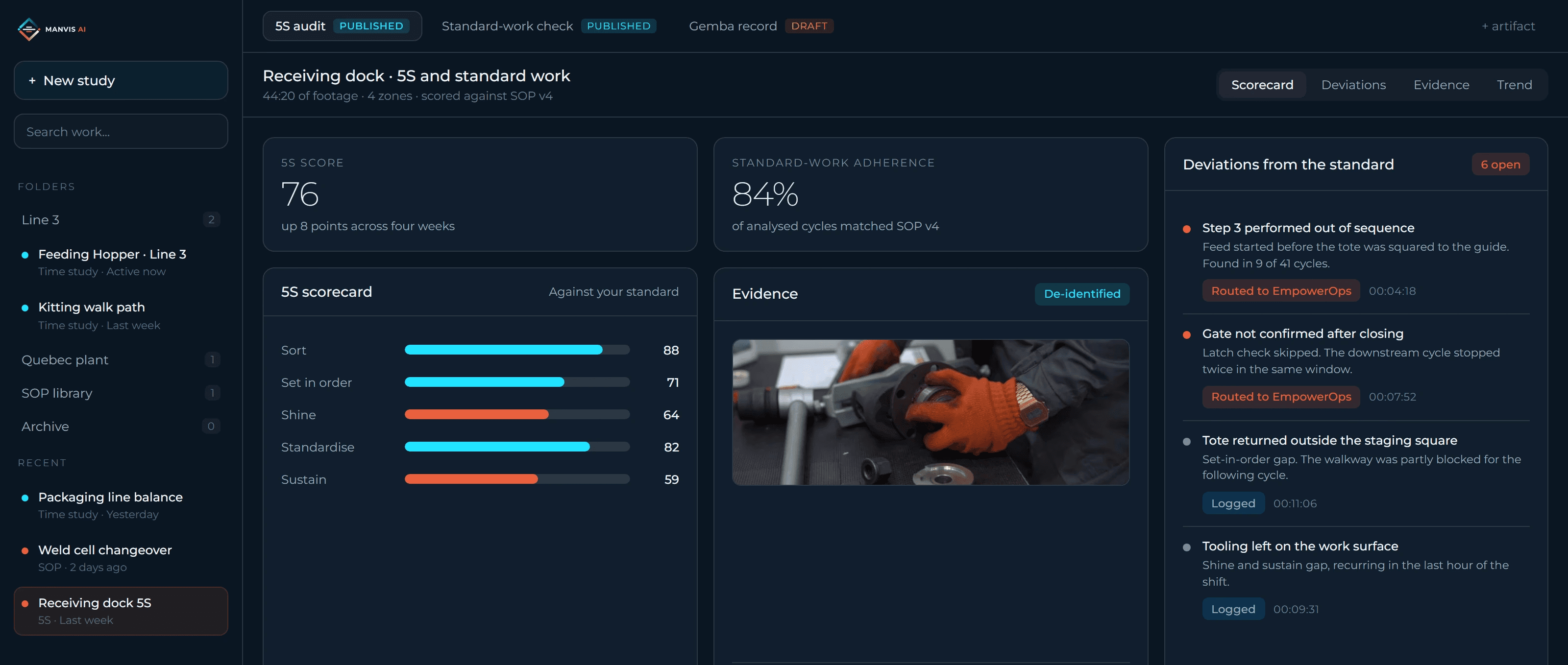
5S scoring, CIL verification, and standard work adherence — monitored continuously from existing cameras. Lean discipline sustained between audits, not just during them.

The Audit Cycle Problem

Lean programs depend on discipline.

The programs themselves are well understood — 5S, CIL routines, standard work. The challenge is not knowing what to do. The challenge is verifying that it gets done. 5S audits happen on a schedule. Between audits, conditions drift. The score at Tuesday's audit may not reflect what the area looked like on Thursday.

Compliance becomes a periodic event instead of a sustained state. CIL tasks — Clean, Inspect, Lubricate — are typically self-reported. Operators check the box.

Whether the task was actually performed to standard is difficult to verify without direct observation, and direct observation does not scale. Standard work adherence faces the same constraint. The defined process sequence exists. Whether operators follow it consistently across every shift depends on supervision availability and audit frequency. Between audits, deviations go undetected.

The common thread: lean compliance verified periodically cannot sustain lean performance continuously.

seven construction workers standing on white field

Why This Matters

The sustainability gap in lean manufacturing is well-documented: 70% of continuous improvement initiatives fail to sustain their gains beyond the first year (Industry Week / LEI). The primary reason is not poor design — it is the erosion of discipline between verification events. A 5S scoring methodology that produces a score once per week creates six days of unmonitored conditions between each measurement. CIL verification that relies on operator self-reporting produces compliance rates that are systematically inflated — actual completion rates are typically 20 to 40% lower than self-reported rates when verified through direct observation. Autonomous maintenance programs, which depend on consistent CIL execution, fail when the verification mechanism is not trustworthy. The cost of unsustained lean programs is not just the lost improvement — it is the organizational cynicism that makes the next initiative harder to launch

How It Works

What Lean & Compliance Vision Does

Continuous 5S Scoring

Cameras monitor work areas and score 5S conditions — Sort, Set in Order, Shine, Standardize, Sustain — continuously. Scores update throughout the shift, not once per audit cycle. Degradation is flagged as it happens. The 5S scoring methodology is configurable to match your plant's existing standards: weighted scoring by category, pass/fail thresholds per zone, and escalation triggers when scores drop below acceptable levels. Unlike periodic audits where the score reflects a single point in time, continuous scoring reveals the pattern — when areas degrade (typically mid-shift), which zones are consistently strong, and where the standard is not being maintained. This data transforms the audit conversation from "what is the score today?" to "how is the trend evolving?"

CIL Compliance Verification

Vision confirms that Clean, Inspect, and Lubricate tasks are performed — not just signed off. Verification is objective, visual, and automatic. Self-reporting is replaced by observed evidence. CIL verification is a cornerstone of autonomous maintenance — the first pillar of Total Productive Maintenance (TPM). When CIL tasks are verified through observation rather than self-report, the data quality that supports autonomous maintenance decisions improves dramatically. The system distinguishes between tasks that were performed to standard and tasks that were completed but insufficiently — a cleaning task that was rushed, an inspection that missed a key checkpoint. This granularity enables targeted coaching rather than blanket re-training.

Standard Work Adherence Monitoring

Process sequences and timing are verified against defined standard work. When an operator deviates — skips a step, changes the sequence, exceeds cycle time — the system identifies it. Continuously, not at the next scheduled audit. Standard work adherence is the mechanism that sustains quality, safety, and productivity gains from improvement events. Without it, kaizen results erode as operators revert to pre-improvement habits. The monitoring captures both the frequency and type of deviations, enabling CI teams to distinguish between training gaps (the operator does not know the standard) and discipline gaps (the operator knows the standard but does not follow it). Each deviation type requires a different response, and the data makes that distinction possible.

Continuous 5S Scoring

Cameras monitor work areas and score 5S conditions — Sort, Set in Order, Shine, Standardize, Sustain — continuously. Scores update throughout the shift, not once per audit cycle. Degradation is flagged as it happens. The 5S scoring methodology is configurable to match your plant's existing standards: weighted scoring by category, pass/fail thresholds per zone, and escalation triggers when scores drop below acceptable levels. Unlike periodic audits where the score reflects a single point in time, continuous scoring reveals the pattern — when areas degrade (typically mid-shift), which zones are consistently strong, and where the standard is not being maintained. This data transforms the audit conversation from "what is the score today?" to "how is the trend evolving?"

Standard Work Adherence Monitoring

Process sequences and timing are verified against defined standard work. When an operator deviates — skips a step, changes the sequence, exceeds cycle time — the system identifies it. Continuously, not at the next scheduled audit. Standard work adherence is the mechanism that sustains quality, safety, and productivity gains from improvement events. Without it, kaizen results erode as operators revert to pre-improvement habits. The monitoring captures both the frequency and type of deviations, enabling CI teams to distinguish between training gaps (the operator does not know the standard) and discipline gaps (the operator knows the standard but does not follow it). Each deviation type requires a different response, and the data makes that distinction possible.

CIL Compliance Verification

Vision confirms that Clean, Inspect, and Lubricate tasks are performed — not just signed off. Verification is objective, visual, and automatic. Self-reporting is replaced by observed evidence. CIL verification is a cornerstone of autonomous maintenance — the first pillar of Total Productive Maintenance (TPM). When CIL tasks are verified through observation rather than self-report, the data quality that supports autonomous maintenance decisions improves dramatically. The system distinguishes between tasks that were performed to standard and tasks that were completed but insufficiently — a cleaning task that was rushed, an inspection that missed a key checkpoint. This granularity enables targeted coaching rather than blanket re-training.

Continuous 5S Scoring

Cameras monitor work areas and score 5S conditions — Sort, Set in Order, Shine, Standardize, Sustain — continuously. Scores update throughout the shift, not once per audit cycle. Degradation is flagged as it happens. The 5S scoring methodology is configurable to match your plant's existing standards: weighted scoring by category, pass/fail thresholds per zone, and escalation triggers when scores drop below acceptable levels. Unlike periodic audits where the score reflects a single point in time, continuous scoring reveals the pattern — when areas degrade (typically mid-shift), which zones are consistently strong, and where the standard is not being maintained. This data transforms the audit conversation from "what is the score today?" to "how is the trend evolving?"

CIL Compliance Verification

Vision confirms that Clean, Inspect, and Lubricate tasks are performed — not just signed off. Verification is objective, visual, and automatic. Self-reporting is replaced by observed evidence. CIL verification is a cornerstone of autonomous maintenance — the first pillar of Total Productive Maintenance (TPM). When CIL tasks are verified through observation rather than self-report, the data quality that supports autonomous maintenance decisions improves dramatically. The system distinguishes between tasks that were performed to standard and tasks that were completed but insufficiently — a cleaning task that was rushed, an inspection that missed a key checkpoint. This granularity enables targeted coaching rather than blanket re-training.

Standard Work Adherence Monitoring

Process sequences and timing are verified against defined standard work. When an operator deviates — skips a step, changes the sequence, exceeds cycle time — the system identifies it. Continuously, not at the next scheduled audit. Standard work adherence is the mechanism that sustains quality, safety, and productivity gains from improvement events. Without it, kaizen results erode as operators revert to pre-improvement habits. The monitoring captures both the frequency and type of deviations, enabling CI teams to distinguish between training gaps (the operator does not know the standard) and discipline gaps (the operator knows the standard but does not follow it). Each deviation type requires a different response, and the data makes that distinction possible.

Measurable Outcomes

Sustain Between Audits

5S and CIL compliance maintained at a consistent level throughout the week, not just on audit days. The gap between audit scores and actual conditions narrows. Plants using continuous monitoring report that the variance between audit-day scores and non-audit-day scores decreases from 15-25 points to less than 5 points.

Replace Self-Reporting with Verification

CIL and standard work compliance based on visual evidence, not operator sign-off. Trust the data because the data is observed, not declared. This shift is foundational for autonomous maintenance progression — plants cannot advance through TPM pillars when the data supporting their progress is unreliable.

Reduce Audit Burden

Scheduled audits shift from compliance verification to improvement coaching. The baseline is already known — the audit conversation starts at a higher level. Audit frequency can be reduced without sacrificing visibility, freeing CI and quality resources for improvement work rather than inspection work.

Audit-Ready Documentation

Continuous compliance data produces audit-ready records automatically. When a customer or certifying body asks for evidence, it exists — timestamped, scored, and traceable. ISO, IATF, and customer-specific audit documentation is generated from operational data rather than assembled before the audit.

Expected Outcomes:

In early deployments, the gap between audit-day 5S scores and actual daily conditions has decreased from 15-25 points to below 5 points.

CIL compliance rates verified through observation are 20-40% more accurate than previously self-reported rates, enabling targeted improvement of autonomous maintenance programs

Audit preparation time has been reduced by approximately 70% through continuous, automatically generated compliance documentation.

Related Modules & Pages

Related Use Cases

See Lean & Compliance Vision at Work

Book a consultation. We will walk through how continuous 5S scoring, CIL verification, and standard work monitoring apply to your lean program — and what sustained compliance looks like without adding audit headcount. Bring your current 5S scorecard. We will show you what continuous looks like.