
MODULE

Measure Every Process. Document It Automatically.

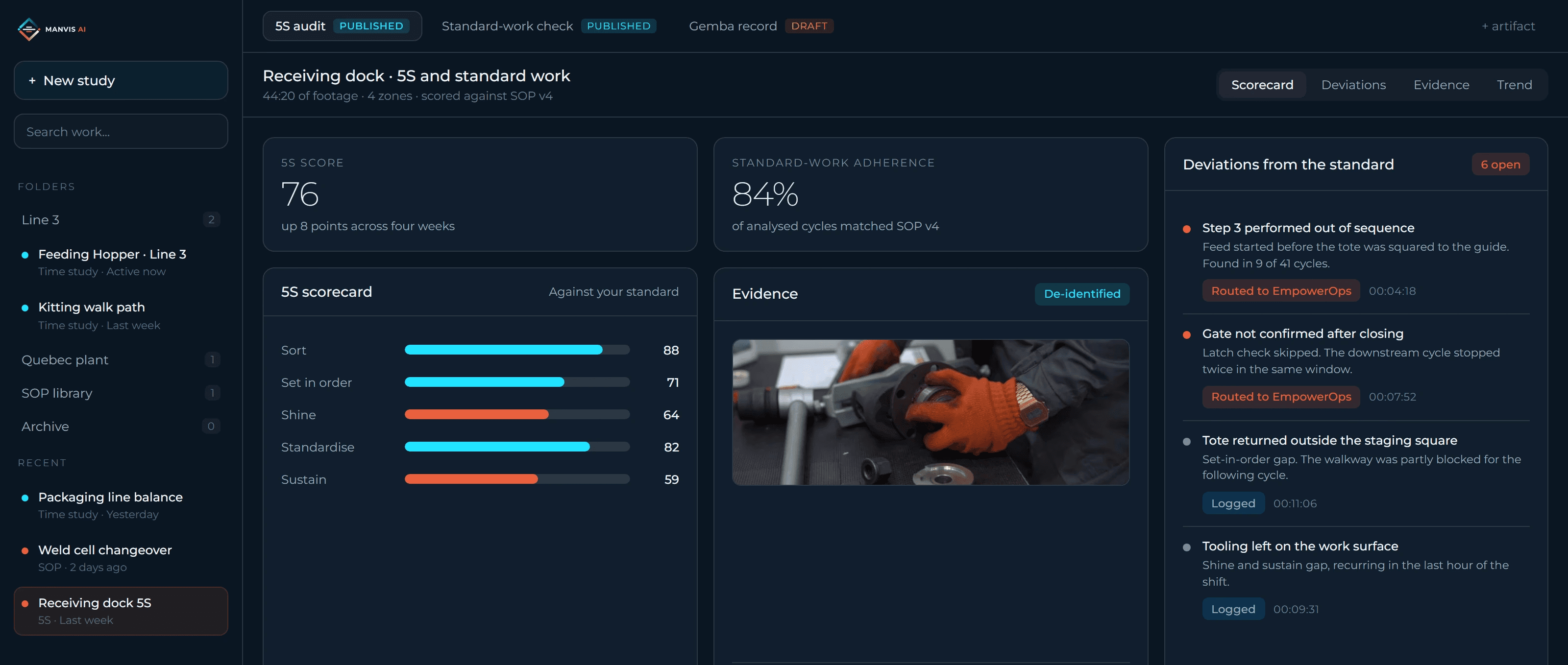
Video-based time studies that complete in hours instead of days. SOPs generated from production footage without an industrial engineer standing at the workstation. Real-time compliance monitoring that flags deviations before they compound.

The IE Bottleneck

A traditional time study takes 2 to 5 days per workstation. Most plants complete fewer than 20% of their planned studies in a given year. The backlog grows.

Cycle time assumptions age. Planning operates on stale data. SOP documentation follows a similar pattern. Creating a structured, accurate SOP from scratch takes weeks per process. Many processes simply go undocumented, leaving tribal knowledge as the operating system.

rocess compliance sits in a third gap. SOPs exist — when they exist — but verification depends on scheduled audits and floor walks. Between audits, deviations accumulate silently. By the time a non-conformance is traced back to process drift, the damage is already in production.

Industrial engineering capacity is finite. The work that depends on it is not. Process Vision changes the ratio.

seven construction workers standing on white field

Why This Matters

IE time studies take 2 to 5 days per workstation; most plants complete less than 20% of planned studies per year (IIE). Every undocumented process is a risk — inconsistent cycle times, unvalidated SOPs, and training gaps that compound with each new hire. The financial impact is substantial: planning models built on stale cycle time data produce infeasible schedules, leading to missed delivery commitments and excessive overtime. VA/NVA (value-added / non-value-added) analysis — the foundation of process improvement — requires accurate time study data. Without it, Lean initiatives target the wrong activities and improvement efforts produce disappointing results. For plants running 50 to 200 workstations, the IE capacity constraint means that the majority of processes operate without current documentation or validated cycle times.

How It Works

What Process Vision Does

Video-Based Time Studies

Upload production video or connect live feeds. Process Vision classifies each activity as value-added or non-value-added automatically. A study that took an IE 2-5 days completes in hours. VA/NVA analysis is the core of process improvement — identifying the activities that add value from the customer's perspective versus those that represent waste (waiting, transport, rework, unnecessary motion). Process Vision performs this classification at scale, across every workstation, without requiring an IE to stand at the station with a stopwatch. The resulting data is statistically robust — based on hundreds or thousands of observed cycles rather than the 10 to 30 cycles typical of a manual study.

Cycle Time Measurement Across Workstations

Process cycle times measured consistently across every station, every shift. Bottlenecks identified from data, not observation. Line balancing decisions grounded in continuous measurement rather than periodic snapshots. Takt time alignment is verified automatically — the system identifies workstations where cycle time exceeds Takt time, creating bottleneck visibility that enables targeted improvement. Cycle time variability is tracked alongside average cycle time, revealing process stability issues that average values alone would mask. This data feeds directly into Asireon production scheduling, ensuring that plans reflect actual floor performance.

Automated SOP Generation

Production video is analyzed and converted into structured standard operating procedures — step sequences, time allocations, key quality points, and safety considerations. Documentation produced without pulling an IE from other work. The generated SOP captures what operators actually do — not what someone remembered they should do. This distinction matters: SOPs built from observation reflect real production conditions, while SOPs built from memory often omit steps, underestimate times, or miss quality-critical details. Each SOP includes visual references from the production footage, making training more effective than text-only documents.

Real-Time SOP Compliance Monitoring

Once an SOP is established, Process Vision monitors adherence continuously. When an operator deviates from the defined sequence or timing, the system flags it in real time — not at the next scheduled audit. Process compliance monitoring closes the gap between "SOP exists" and "SOP is followed." Deviations are classified by type — sequence changes, step omissions, timing variations — allowing quality and CI teams to distinguish between intentional improvements and unintentional drift. When a deviation is flagged, it routes into EmpowerOps as a corrective action or a coaching opportunity, depending on severity.

Video-Based Time Studies

Upload production video or connect live feeds. Process Vision classifies each activity as value-added or non-value-added automatically. A study that took an IE 2-5 days completes in hours. VA/NVA analysis is the core of process improvement — identifying the activities that add value from the customer's perspective versus those that represent waste (waiting, transport, rework, unnecessary motion). Process Vision performs this classification at scale, across every workstation, without requiring an IE to stand at the station with a stopwatch. The resulting data is statistically robust — based on hundreds or thousands of observed cycles rather than the 10 to 30 cycles typical of a manual study.

Automated SOP Generation

Production video is analyzed and converted into structured standard operating procedures — step sequences, time allocations, key quality points, and safety considerations. Documentation produced without pulling an IE from other work. The generated SOP captures what operators actually do — not what someone remembered they should do. This distinction matters: SOPs built from observation reflect real production conditions, while SOPs built from memory often omit steps, underestimate times, or miss quality-critical details. Each SOP includes visual references from the production footage, making training more effective than text-only documents.

Real-Time SOP Compliance Monitoring

Once an SOP is established, Process Vision monitors adherence continuously. When an operator deviates from the defined sequence or timing, the system flags it in real time — not at the next scheduled audit. Process compliance monitoring closes the gap between "SOP exists" and "SOP is followed." Deviations are classified by type — sequence changes, step omissions, timing variations — allowing quality and CI teams to distinguish between intentional improvements and unintentional drift. When a deviation is flagged, it routes into EmpowerOps as a corrective action or a coaching opportunity, depending on severity.

Cycle Time Measurement Across Workstations

Process cycle times measured consistently across every station, every shift. Bottlenecks identified from data, not observation. Line balancing decisions grounded in continuous measurement rather than periodic snapshots. Takt time alignment is verified automatically — the system identifies workstations where cycle time exceeds Takt time, creating bottleneck visibility that enables targeted improvement. Cycle time variability is tracked alongside average cycle time, revealing process stability issues that average values alone would mask. This data feeds directly into Asireon production scheduling, ensuring that plans reflect actual floor performance.

Video-Based Time Studies

Upload production video or connect live feeds. Process Vision classifies each activity as value-added or non-value-added automatically. A study that took an IE 2-5 days completes in hours. VA/NVA analysis is the core of process improvement — identifying the activities that add value from the customer's perspective versus those that represent waste (waiting, transport, rework, unnecessary motion). Process Vision performs this classification at scale, across every workstation, without requiring an IE to stand at the station with a stopwatch. The resulting data is statistically robust — based on hundreds or thousands of observed cycles rather than the 10 to 30 cycles typical of a manual study.

Real-Time SOP Compliance Monitoring

Once an SOP is established, Process Vision monitors adherence continuously. When an operator deviates from the defined sequence or timing, the system flags it in real time — not at the next scheduled audit. Process compliance monitoring closes the gap between "SOP exists" and "SOP is followed." Deviations are classified by type — sequence changes, step omissions, timing variations — allowing quality and CI teams to distinguish between intentional improvements and unintentional drift. When a deviation is flagged, it routes into EmpowerOps as a corrective action or a coaching opportunity, depending on severity.

Automated SOP Generation

Production video is analyzed and converted into structured standard operating procedures — step sequences, time allocations, key quality points, and safety considerations. Documentation produced without pulling an IE from other work. The generated SOP captures what operators actually do — not what someone remembered they should do. This distinction matters: SOPs built from observation reflect real production conditions, while SOPs built from memory often omit steps, underestimate times, or miss quality-critical details. Each SOP includes visual references from the production footage, making training more effective than text-only documents.

Cycle Time Measurement Across Workstations

Process cycle times measured consistently across every station, every shift. Bottlenecks identified from data, not observation. Line balancing decisions grounded in continuous measurement rather than periodic snapshots. Takt time alignment is verified automatically — the system identifies workstations where cycle time exceeds Takt time, creating bottleneck visibility that enables targeted improvement. Cycle time variability is tracked alongside average cycle time, revealing process stability issues that average values alone would mask. This data feeds directly into Asireon production scheduling, ensuring that plans reflect actual floor performance.

Measurable Outcome

Recover IE Capacity

Time studies that consumed days now complete in hours. Your IE team focuses on improvement projects, not stopwatch exercises. For a typical mid-market plant, this recovers 30 to 50% of IE capacity — capacity that can be redirected to value stream mapping, process redesign, and kaizen facilitation.

Document the Undocumented

Processes that have run for years without formal SOPs get structured documentation — generated from video, not from memory. The SOP gap closes systematically rather than depending on IE availability. SOP coverage increases from the typical 30-50% of processes to near-complete documentation within months.

Continuous Compliance, Not Periodic Audits

Process deviations caught as they happen. The gap between "SOP exists" and "SOP is followed" closes from weeks to seconds. Process compliance becomes a continuous metric rather than a periodic audit score, enabling immediate coaching and correction.

Accurate Planning Inputs

Cycle time data flows from Process Vision into Asireon, ensuring production plans reflect actual floor performance — not assumptions from last quarter's study. When cycle times change due to process improvements, material changes, or workforce shifts, the planning system updates automatically.

Expected Outcomes:

In early deployments, time study completion rates have increased from less than 20% of planned studies to over 90%, eliminating the IE backlog.

SOP coverage has increased from 30-50% of processes to above 85% within the first six months of deployment.

Cycle time variability has decreased by 15-25% as continuous compliance monitoring catches and corrects process deviations in real time.

Related Modules & Pages

Related Use Cases

See Process Vision on Your Floor

Book a consultation. We will walk through how Process Vision applies to your time study backlog, your SOP gaps, and your compliance requirements — and how video-based analysis changes what your IE team can accomplish. Bring your most complex workstation. We will show you what a study looks like in hours, not days.