


MODULE

Tier Meeting Series — Structured Meetings That Produce Trackable Outcomes

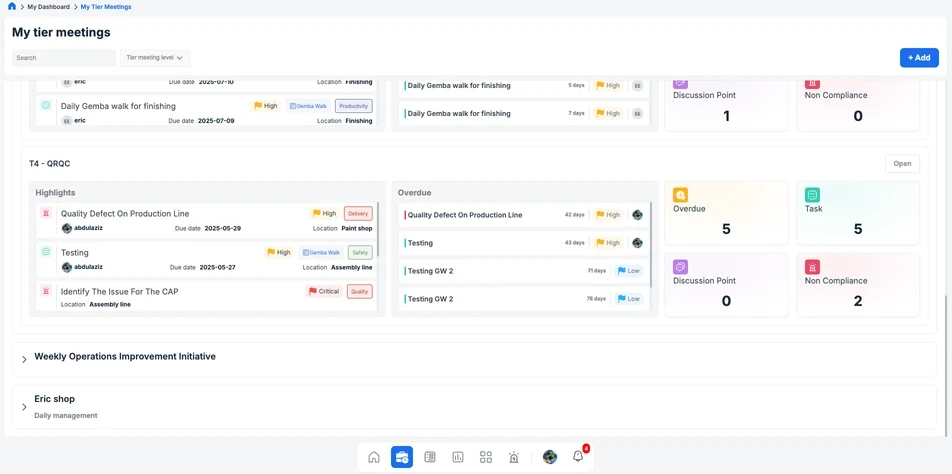
Run tiered daily management meetings with visual agendas, structured discussion flows, automatic task generation, and cross-tier escalation — so nothing agreed upon gets forgotten.

Built for every level of the organization, from Tier 1 team huddles on the Gemba to Tier 4 executive leadership reviews in the boardroom.


The Problem This Solves

Meetings Happen. Follow-Through Does Not.

Tier meetings are a cornerstone of Lean daily management. Most plants run them. The problem is not frequency — it is output. Actions are discussed, agreed upon, and forgotten by the next meeting. There is no structured way to capture what was decided, assign it to someone, or track whether it was done. Escalations between tiers happen verbally, and by the time an issue reaches the right level, days have passed.

The tier structure itself — Tier 1 daily huddles at the Gemba, Tier 2 weekly line-level reviews, Tier 3 monthly plant reviews, Tier 4 quarterly executive sessions — is designed as a cascading information system. But without a digital backbone, the cascade breaks. A safety concern raised in a Tier 1 huddle gets mentioned to the supervisor, who may or may not bring it to the Tier 2 meeting, where it may or may not be documented, and the resolution may or may not be tracked. At each handoff, context is lost and urgency fades.


seven construction workers standing on white field

Why This Matters

Studies of Lean daily management systems consistently find that the number one failure mode is not the absence of meetings — it is the absence of actionable output from those meetings. Plants that run tier meetings without structured follow-through report that fewer than 40% of agreed actions are completed on time. The meetings create the illusion of management discipline while the actual operational problems persist. The time invested in meetings — often 30 to 60 minutes per tier level, across multiple tiers, every day — becomes a cost rather than a value driver when the output disappears between sessions.

How It Works

From Discussion to Documented Action in Minutes

Visual Agenda Builder

Build standardized agendas for each tier level. Include KPI reviews, safety updates, quality issues, and open items. The agenda becomes the meeting — consistent, repeatable, and time-boxed. Tier 1 agendas focus on immediate floor conditions: safety observations, quality alerts, production targets, and 5S status. Tier 2 agendas add weekly KPI trends, open CAPA items, and LSW adherence. Tier 3 and Tier 4 agendas incorporate OEE trends, cross-departmental escalations, and strategic initiative progress. Each level sees the information appropriate to its decision-making scope.

Outcome Documentation

Every meeting produces a structured record: what was discussed, what was decided, what tasks were created, and what was escalated. Available immediately to all participants and stakeholders. The documentation is automatic — generated from the meeting flow itself, not compiled afterward by a designated note-taker. This record becomes the input for the next meeting and the evidence base for continuous improvement reviews.

Structured Meeting Flow

Guide facilitators through each agenda item with prompts and time allocations. Reduce meeting drift. Keep discussions focused on decisions and actions, not status recaps. The facilitation framework enforces the discipline that makes tier meetings effective: each item has a defined time box, a clear owner, and a required outcome — decision, action, or escalation. Meetings that consistently ran 45 minutes compress to 20 when the structure eliminates repetition and tangents.

Cross-Tier Escalation

Issues that cannot be resolved at the current tier are escalated to the next level with full context attached. The receiving tier sees the issue in their agenda automatically. No information is lost between levels. A quality concern raised at Tier 1 arrives at Tier 2 with the original observation, photos, initial response, and the reason it requires escalation. The Tier 2 facilitator does not need to ask "what happened?" — the context is already there.

Auto-Task Generation

When an issue is raised during a meeting, a task is created on the spot — with owner, deadline, and context. No separate step. No post-meeting minutes that no one reads. The task inherits the tier level, the meeting date, and the discussion context, creating a traceable link between the conversation and the action. This is the mechanism that converts meeting time into operational output.

Visual Agenda Builder

Build standardized agendas for each tier level. Include KPI reviews, safety updates, quality issues, and open items. The agenda becomes the meeting — consistent, repeatable, and time-boxed. Tier 1 agendas focus on immediate floor conditions: safety observations, quality alerts, production targets, and 5S status. Tier 2 agendas add weekly KPI trends, open CAPA items, and LSW adherence. Tier 3 and Tier 4 agendas incorporate OEE trends, cross-departmental escalations, and strategic initiative progress. Each level sees the information appropriate to its decision-making scope.

Auto-Task Generation

When an issue is raised during a meeting, a task is created on the spot — with owner, deadline, and context. No separate step. No post-meeting minutes that no one reads. The task inherits the tier level, the meeting date, and the discussion context, creating a traceable link between the conversation and the action. This is the mechanism that converts meeting time into operational output.

Cross-Tier Escalation

Issues that cannot be resolved at the current tier are escalated to the next level with full context attached. The receiving tier sees the issue in their agenda automatically. No information is lost between levels. A quality concern raised at Tier 1 arrives at Tier 2 with the original observation, photos, initial response, and the reason it requires escalation. The Tier 2 facilitator does not need to ask "what happened?" — the context is already there.

Structured Meeting Flow

Guide facilitators through each agenda item with prompts and time allocations. Reduce meeting drift. Keep discussions focused on decisions and actions, not status recaps. The facilitation framework enforces the discipline that makes tier meetings effective: each item has a defined time box, a clear owner, and a required outcome — decision, action, or escalation. Meetings that consistently ran 45 minutes compress to 20 when the structure eliminates repetition and tangents.

Outcome Documentation

Every meeting produces a structured record: what was discussed, what was decided, what tasks were created, and what was escalated. Available immediately to all participants and stakeholders. The documentation is automatic — generated from the meeting flow itself, not compiled afterward by a designated note-taker. This record becomes the input for the next meeting and the evidence base for continuous improvement reviews.

Visual Agenda Builder

Build standardized agendas for each tier level. Include KPI reviews, safety updates, quality issues, and open items. The agenda becomes the meeting — consistent, repeatable, and time-boxed. Tier 1 agendas focus on immediate floor conditions: safety observations, quality alerts, production targets, and 5S status. Tier 2 agendas add weekly KPI trends, open CAPA items, and LSW adherence. Tier 3 and Tier 4 agendas incorporate OEE trends, cross-departmental escalations, and strategic initiative progress. Each level sees the information appropriate to its decision-making scope.

Structured Meeting Flow

Guide facilitators through each agenda item with prompts and time allocations. Reduce meeting drift. Keep discussions focused on decisions and actions, not status recaps. The facilitation framework enforces the discipline that makes tier meetings effective: each item has a defined time box, a clear owner, and a required outcome — decision, action, or escalation. Meetings that consistently ran 45 minutes compress to 20 when the structure eliminates repetition and tangents.

Auto-Task Generation

When an issue is raised during a meeting, a task is created on the spot — with owner, deadline, and context. No separate step. No post-meeting minutes that no one reads. The task inherits the tier level, the meeting date, and the discussion context, creating a traceable link between the conversation and the action. This is the mechanism that converts meeting time into operational output.

Outcome Documentation

Every meeting produces a structured record: what was discussed, what was decided, what tasks were created, and what was escalated. Available immediately to all participants and stakeholders. The documentation is automatic — generated from the meeting flow itself, not compiled afterward by a designated note-taker. This record becomes the input for the next meeting and the evidence base for continuous improvement reviews.

Cross-Tier Escalation

Issues that cannot be resolved at the current tier are escalated to the next level with full context attached. The receiving tier sees the issue in their agenda automatically. No information is lost between levels. A quality concern raised at Tier 1 arrives at Tier 2 with the original observation, photos, initial response, and the reason it requires escalation. The Tier 2 facilitator does not need to ask "what happened?" — the context is already there.

What Changes When Tier Meetings Produce Real Output

Reduce average meeting time by 25%

Structured agendas and facilitation prompts eliminate drift and repetition. Meetings stay within their time box. Across a plant running four tier levels, the cumulative time savings reach several hours per week of leadership time redirected to the floor.

100% of meeting actions tracked to closure

Every action agreed upon in a tier meeting becomes a task with a deadline and an owner. Nothing exists only in someone's memory. The completion rate of tier meeting actions — a lagging indicator of daily management system health — becomes visible and measurable for the first time.

Seamless escalation across tiers

Issues move up with context intact. No re-explaining. No delays waiting for the next weekly review. The escalation path from Tier 1 daily huddle to Tier 4 executive review is digital, documented, and immediate when the situation demands it.

A documented record of daily management decisions

Useful for audits, continuous improvement reviews, and leadership visibility into how the management system is functioning. When an auditor or customer asks how decisions are made and tracked, the answer is systematic — not anecdotal.

Expected Outcomes:

Plants implementing structured tier meetings report that action completion rates increase from below 40% to above 85% within the first quarter.

Average meeting duration decreases by 20-30% while the quality and traceability of meeting output increases significantly.

Cross-tier escalation time — the lag between an issue being raised at a lower tier and reaching the appropriate decision-maker — drops from days to hours.
See EmpowerOps in Action

See how the Tier Meeting Series turns your daily management meetings into a structured system with trackable outcomes. We will walk you through a live tier meeting flow — from Tier 1 huddle to Tier 3 review — and show you how actions, escalations, and documentation work as a connected system.