


MODULE

Task Management — One System for Every Task on the Floor

Create, assign, track, escalate, and close tasks with full context — photos, comments, subtasks, and deadlines — all in one place.

Built for operators, supervisors, CI managers, and plant leaders who need clarity on what is open, what is overdue, and what fell through the cracks.


The Problem This Solves

Your plant runs on tasks. But today, those tasks are scattered across email threads, WhatsApp groups, shared drives, and verbal agreements made during shift handover. There is no single system that tracks who owns what, when it is due, or whether it was completed. When something falls through the cracks — and it will — there is no escalation path. The task simply disappears until the problem resurfaces, usually larger than before.

Cross-shift handover is where the most critical information is lost. A corrective action discussed in the morning meeting never reaches second shift. A maintenance request raised verbally at Gemba disappears when the supervisor moves to the next area. The accountability chain breaks at every transition point — between shifts, between departments, between tier levels — because there is no system holding it together.


seven construction workers standing on white field

Why This Matters

The average mid-market manufacturer has 200 to 500 open tasks across their operation at any given time. When 30% of those are overdue and nobody knows, the cost is not just missed deadlines — it is quality escapes, safety incidents, and CI initiatives that stall before they deliver results. Research from the Lean Enterprise Institute indicates that unstructured task management is the most cited reason for failed continuous improvement programs. The gap between "we agreed to do it" and "it actually got done" is where operational discipline lives or dies.

How It Works

Five capabilities that turn scattered tasks into a closed-loop system.

Task Creation with Full Context

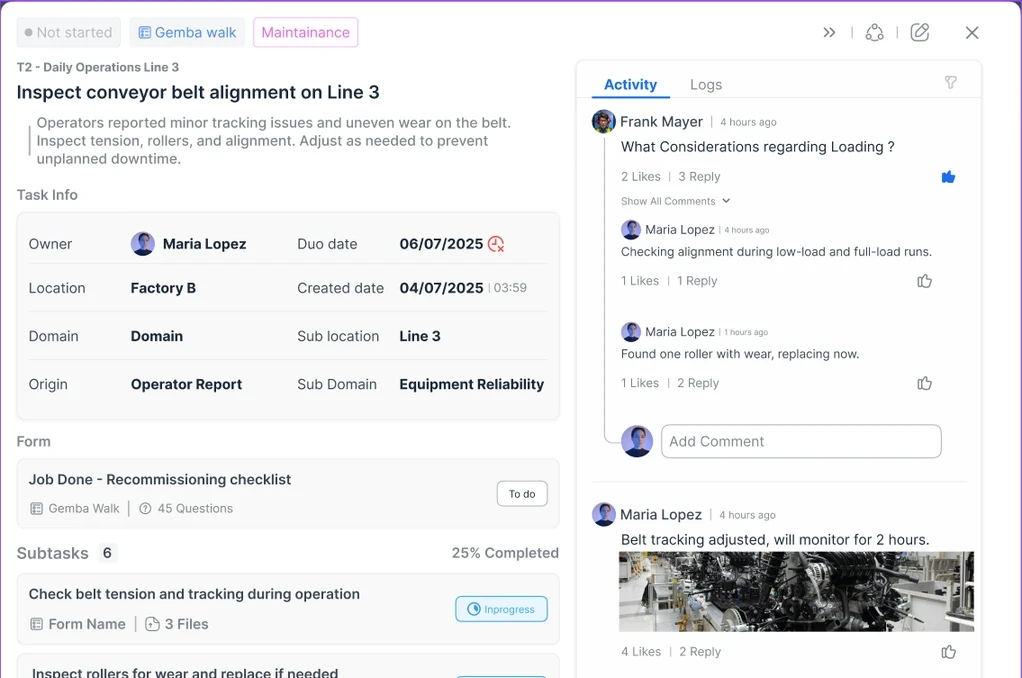
Create tasks directly from the floor. Attach photos, add comments, link to related issues. Every task carries the context needed to act on it without a follow-up conversation. This matters because manufacturing tasks are inherently visual — a photo of the defect, the machine condition, or the safety hazard communicates what a text description cannot. When the assignee opens the task, they understand what to do and why, without tracking down the person who raised it.

Subtask Decomposition

Break complex corrective actions into manageable steps. Track each subtask independently while maintaining visibility on the parent task. A CAPA with five action items does not need to be managed as a single monolithic task. Each step has its own owner, deadline, and status — and the parent task reflects aggregate progress. This is essential for A3-style problem solving where corrective actions span multiple departments and timelines.

Assignment with Deadlines

Assign tasks to individuals or teams with clear due dates. No ambiguity about ownership. No confusion about priority. In plants running two or three shifts, clear assignment is the difference between a task completed on time and a task that sits untouched because both shifts assumed the other would handle it. The system enforces single-owner accountability while supporting team-based execution through subtask delegation.

Cross-Shift Handover Visibility

Every task persists across shifts with its full history intact. Incoming shift leaders see exactly what was started, what was completed, and what is pending — without relying on verbal handover or paper logs. The system serves as the single source of truth for operational continuity, ensuring that no task is orphaned at shift change.

Automatic Escalation Rules

Define escalation pathways before problems grow. If a task is not addressed within the defined window, it moves up the chain automatically — from operator to supervisor, from supervisor to area manager, from area manager to plant leadership. No manual follow-up required. Escalation rules are configurable by task type, severity, and department, ensuring that critical corrective actions receive attention proportional to their impact.

Status Tracking and Notifications

Real-time status updates keep everyone aligned. Assignees receive notifications on assignment, approaching deadlines, and escalation. Managers see the full picture without asking for it. The notification system is role-aware — floor operators receive mobile push notifications, supervisors see dashboard alerts, and plant managers receive daily digest summaries of overdue and escalated items.

Task Creation with Full Context

Create tasks directly from the floor. Attach photos, add comments, link to related issues. Every task carries the context needed to act on it without a follow-up conversation. This matters because manufacturing tasks are inherently visual — a photo of the defect, the machine condition, or the safety hazard communicates what a text description cannot. When the assignee opens the task, they understand what to do and why, without tracking down the person who raised it.

Automatic Escalation Rules

Define escalation pathways before problems grow. If a task is not addressed within the defined window, it moves up the chain automatically — from operator to supervisor, from supervisor to area manager, from area manager to plant leadership. No manual follow-up required. Escalation rules are configurable by task type, severity, and department, ensuring that critical corrective actions receive attention proportional to their impact.

Cross-Shift Handover Visibility

Every task persists across shifts with its full history intact. Incoming shift leaders see exactly what was started, what was completed, and what is pending — without relying on verbal handover or paper logs. The system serves as the single source of truth for operational continuity, ensuring that no task is orphaned at shift change.

Assignment with Deadlines

Assign tasks to individuals or teams with clear due dates. No ambiguity about ownership. No confusion about priority. In plants running two or three shifts, clear assignment is the difference between a task completed on time and a task that sits untouched because both shifts assumed the other would handle it. The system enforces single-owner accountability while supporting team-based execution through subtask delegation.

Subtask Decomposition

Break complex corrective actions into manageable steps. Track each subtask independently while maintaining visibility on the parent task. A CAPA with five action items does not need to be managed as a single monolithic task. Each step has its own owner, deadline, and status — and the parent task reflects aggregate progress. This is essential for A3-style problem solving where corrective actions span multiple departments and timelines.

Status Tracking and Notifications

Real-time status updates keep everyone aligned. Assignees receive notifications on assignment, approaching deadlines, and escalation. Managers see the full picture without asking for it. The notification system is role-aware — floor operators receive mobile push notifications, supervisors see dashboard alerts, and plant managers receive daily digest summaries of overdue and escalated items.

Task Creation with Full Context

Create tasks directly from the floor. Attach photos, add comments, link to related issues. Every task carries the context needed to act on it without a follow-up conversation. This matters because manufacturing tasks are inherently visual — a photo of the defect, the machine condition, or the safety hazard communicates what a text description cannot. When the assignee opens the task, they understand what to do and why, without tracking down the person who raised it.

Assignment with Deadlines

Assign tasks to individuals or teams with clear due dates. No ambiguity about ownership. No confusion about priority. In plants running two or three shifts, clear assignment is the difference between a task completed on time and a task that sits untouched because both shifts assumed the other would handle it. The system enforces single-owner accountability while supporting team-based execution through subtask delegation.

Automatic Escalation Rules

Define escalation pathways before problems grow. If a task is not addressed within the defined window, it moves up the chain automatically — from operator to supervisor, from supervisor to area manager, from area manager to plant leadership. No manual follow-up required. Escalation rules are configurable by task type, severity, and department, ensuring that critical corrective actions receive attention proportional to their impact.

Subtask Decomposition

Break complex corrective actions into manageable steps. Track each subtask independently while maintaining visibility on the parent task. A CAPA with five action items does not need to be managed as a single monolithic task. Each step has its own owner, deadline, and status — and the parent task reflects aggregate progress. This is essential for A3-style problem solving where corrective actions span multiple departments and timelines.

Cross-Shift Handover Visibility

Every task persists across shifts with its full history intact. Incoming shift leaders see exactly what was started, what was completed, and what is pending — without relying on verbal handover or paper logs. The system serves as the single source of truth for operational continuity, ensuring that no task is orphaned at shift change.

Status Tracking and Notifications

Real-time status updates keep everyone aligned. Assignees receive notifications on assignment, approaching deadlines, and escalation. Managers see the full picture without asking for it. The notification system is role-aware — floor operators receive mobile push notifications, supervisors see dashboard alerts, and plant managers receive daily digest summaries of overdue and escalated items.

What Changes When Tasks Stop Falling Through the Cracks

Reduce task closure time by up to 40%

Deadlines, escalation rules, and visibility create accountability that email and WhatsApp cannot. When every task has an owner, a due date, and an automatic escalation path, the organizational drag that inflates resolution timelines disappears.

Eliminate status meetings that exist only to ask "where are we on this?

Real-time tracking replaces verbal updates and follow-up messages. The time recovered is significant — plants report reclaiming 3 to 5 hours per week of supervisor time previously spent chasing task status across departments.

Full audit trail on every task

now who created it, who owned it, when it was escalated, and how it was resolved. Useful for ISO and IATF compliance reviews, customer audits, and continuous improvement retrospectives. The trail is automatic — no one needs to maintain a separate log.

One system for all roles

From operators raising issues to directors reviewing resolution rates, Task Management serves every level of the organization. The same task that begins as a floor-level observation becomes a data point in plant-wide performance dashboards.

Expected Outcomes:

In early deployments, plants have reported a 35-40% reduction in average task closure time within the first 90 days of adoption.

Overdue task rates typically drop from 25-35% to below 10% once escalation rules are active and visible to leadership.

Cross-shift task loss — tasks raised on one shift that are never actioned — is effectively eliminated through persistent digital tracking.
See EmpowerOps in Action

Learn how Task Management fits into your daily management system. We will walk you through a live environment — no slides, no fluff. You will see how tasks are created, assigned, escalated, and closed in a system built for the realities of the shop floor.