

MODULE
The Analysis Becomes Tracked Action.
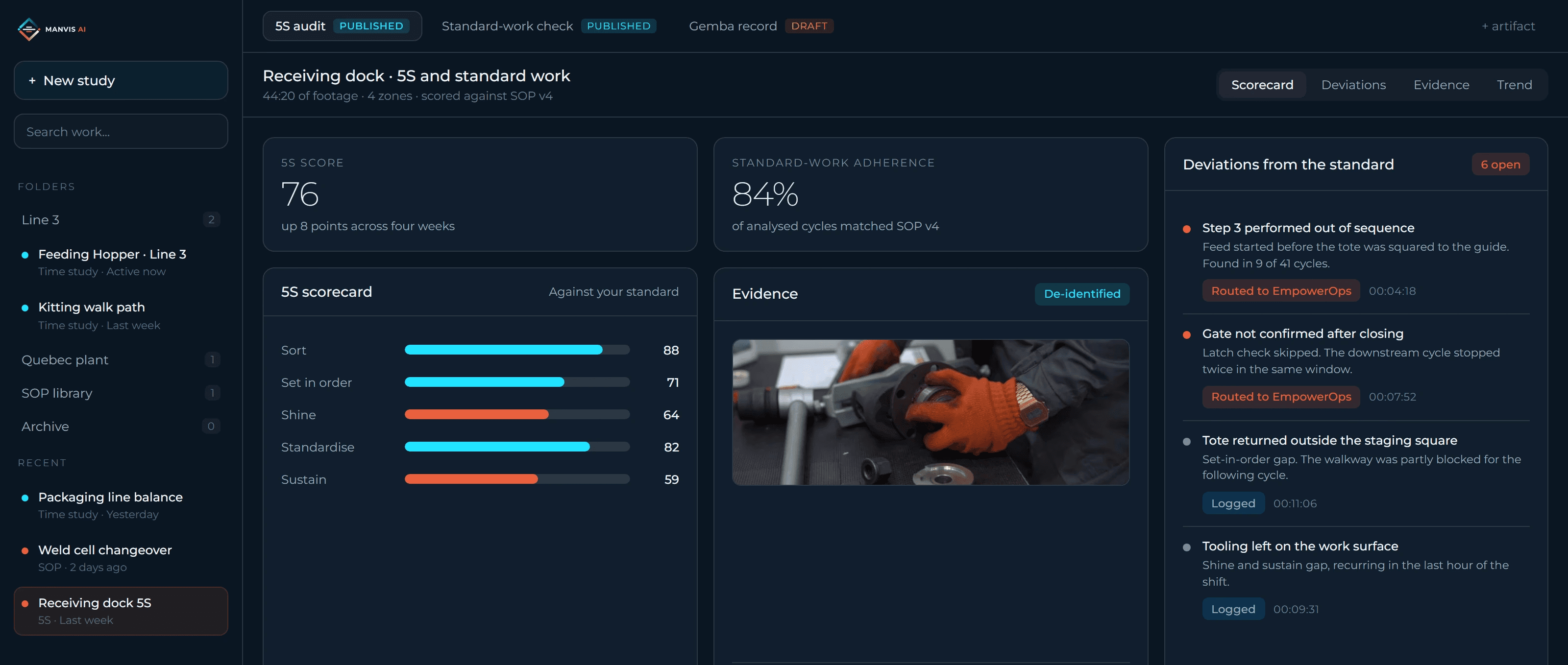
Manvis does not stop at the analysis. Every finding, every time study, every compliance score flows into EmpowerOps and Asireon, raising non-conformances, assigning corrective actions with owners and deadlines, and updating the cycle times the plan is built on. The loop between the finding and the fix closes without anyone re-keying it.

The Disconnection Problem
Most analysis stops at the report.
A finding is recorded somewhere, and then it waits. Somebody has to read the report, decide it matters, open a record in a different system, retype what the first system already knew, and find an owner. Each of those steps is a place the finding can stop moving, and most of them are somebody being busy rather than somebody deciding.
Days pass. Some findings never reach a workflow at all, not because anyone judged them unimportant but because nothing carried them there. The problem is not the quality of the analysis, and buying better analysis does not fix it. The problem is that the analysis and the action sit in different systems, owned by different teams, on different timelines, and the gap between them is where the value the analysis created quietly disappears


Why This Matters
This is where most industrial AI fails to pay for itself. McKinsey work on industrial AI adoption puts it plainly: most of the value arrives only when the output is connected to the workflow that acts on it. Everything before that point is a report. A report is not worth nothing, but it is worth a great deal less than an owned action with a date on it, and the difference between the two is not analytical quality. It is plumbing. Without the connection you have bought a very good way of knowing, attached to the same organisation that was already slow to act on what it knew. The finding ages, the work carries on against the standard that was already slipping, and the investigation eventually starts from stale information.
How It Works
How Integration Closes the Loop
No Lag Between Finding and Action
The non-conformance exists as soon as the analysis is returned. Nothing waits for someone to read a report, judge it, and type it into a second system. That removes the most common failure in the chain, which is not a bad decision but no decision, taken by nobody, because the finding never arrived anywhere that would force one.
Planning That Reflects Reality
Production plans built on measured cycle times rather than quarterly assumptions. The planner is not guessing at how long the work takes, and when the answer changes the next study changes it in the plan, rather than the plan being wrong until someone notices.
Closed-Loop Corrective Action
Deviation found, non-conformance created, CAPA assigned, resolution tracked, effect verified. Every step has an owner and a date, and the trail exists without anyone assembling it afterwards. Closed loop stops being a diagram in a management presentation and becomes the ordinary path a finding takes.
Compounding Intelligence
Every study adds to what the plant knows about its own work. Recurring deviations show where the standard itself needs changing rather than where a shift missed it. Each analysis contributes to more than one decision system at once, which is the advantage an integrated platform has over three point solutions that each know one thing.
Expected Outcomes:
A finding becomes an owned action on the day it is returned rather than the week after.
Root cause analysis starts from current information and the evidence is already attached to the record.
Cycle times in the plan match the ones on the floor.
Recurring problems get treated as design problems instead of being closed twenty separate times.
And the audit trail exists as a by-product of the work, which is the only version of it that survives contact with a busy month.

Related Modules & Pages
See the Full Loop in Action
Book a consultation. We will walk through how Manvis connects to EmpowerOps and Asireon in your environment how a finding becomes tracked action, how the platform closes the loop between analysing, planning and doing, and how the SENSE-PLAN-EXECUTE architecture creates compounding value from every observation.